Saturday, November 28, 2015

Bush backs Obama, Turkey in Russian warplane dispute


Link: http://www.cnn.com/2015/11/25/politics/jeb-bush-turkey-russia-obama/index.html

Jeb Bush said Wednesday he supports Turkey in the dispute that resulted in Russian warplane being shot down Tuesday near the border between Turkey and Syria. Bush told CNN's Alisyn Camerota on "New Day." "If we're serious about that, Turkey needs to be an ally and we need to show support. I think President Obama was correct to say that every country has a right to self-defense."Obama said Tuesday that Turkey has a right to defend its airspace, but also urged the two countries to communicate better to de-escalate tensions as Russia continues operations near the Turkish-Syrian border. Turkey said they shot the plane after it violated Turkey's airspace and ignored 10 warning. However, Russia claimed their plane was down over Syrian territory by an air-to-air missile from a Turkish F-16 jet. Bush said Wednesday that Russia could be an ally in the fight against ISIS, but added that would require the U.S. setting requirements for working with Russia and Russia abandoning its alliance with Iran in support of Syrian President Bashar al-Assad.
Question: Do you agree with what President Obama said Tuesday? Is this right to say when we are ally with Russia in the fight against ISIS? Who should be our ally and who is our ally now?

Monday, November 23, 2015

Give me your tired, your poor, but not your Syrian refugees


Summary:
While ISIS continues their push into Syria, many governors have come out against admitting refugees into their states. Govenor Greg Abbott of Texas claimed “Security comes first” and he demanded “the U.S. act similarly.” These governors have ordered their state bureaucracies to not cooperate with federal relocation programs, citing the cost of it and possible terrorist risks. In the light of the recent Paris attack, their fears are not unfounded, as several of the perpetrators seem to have entered France amongst the refugees. However, Europe’s refugees are drastically different than the ones the White House plan to admit to the United States. For starters, they are thoroughly vetted by the UN, then by the FBI, and finally by the Department of Defense. The United States will also be admitting families only, while most of Europe’s refugees are young males. Given all of these factors, it is highly unlikely that the refugees will pose any risk. Furthermore, they are not entering by the millions, but the hundreds. Since 2012, the US has only admitted 1500 refugees, although the White House plans to admit 10,000 more by the end of 2016. However, these are paltry sums when you consider that over 200,000 Vietnamese and 100,000 Cuban refugees were admitted in 1979-1980. Given this historical background, the situation seems fairly ridiculous; we are not talking about states closing its borders to hundreds of thousands of desperate refugees, but rather Mississippi turning away all 3 people who might want to live there.


Questions:
Should the United States admit Syrian refugees at all?
If not, what should be done about them?
If so, should the United States admit more? Canada has committed to 25,000 refugees. If the federal government were to match that figure proportionally, it would have to admit around 250,000 refugees. Do you think it should admit that many?
Should the states have the authority to say no to federal relocation programs?
Should the US do more to protect Syria from ISIS, thereby eliminating the refugee crisis at the stem?

Sunday, November 22, 2015

ISIS: Killers with Good Social Media?


Link: http://www.cnn.com/2015/11/22/politics/obama-isis-killers-social-media/


At a press conference in Malaysia this weekend, President Obama labeled ISIS as "Killers with good social media." The quote was made in response to the terror group's social media presence and reports made that suggest the terror attacks in Paris were foretold of on social media. The President decided to strengthen his rhetoric in regards to the terror group following criticism he had received earlier from his response to the Paris terror attacks, having originally described the attacks to be "a setback in the war against ISIS." The president vowed to not let ISIS tactics of fear break the spirits of the American people. The President has been under extreme scrutiny for declaring that the U.S. should take in at least 10,000 Syrian refugees within the next year. Congress voted to suspend immigration programs for Syrian and Iraqi immigrants until the immigrants can be cleared as harmless by national security agencies. ISIS seems unpredictable, but social media may be our best bet for preventing further strikes.

Questions: Should U.S. Security agencies focus on monitoring ISIS on social media, tracking their possible IP Addresses and looking for any potential threats? Should the U.S. value the safety of the Syrian refugees and accept them into the country, or require maximum security to ensure that each individual immigrant is not a threat? Should the U.S. continue air strikes throughout ISIS regions, or mobilize soldiers to strike from land?


Super PACs and State Elections


Summary: Political action committees or as they're more commonly referred to, PACs, are political independent expenditure-only committees created for the sole purpose of raising and spending certain amounts of money for political reasons. These funds along with campaign contribution from donors are then used by the PACs to elect or defeat political candidates. A new type of PAC was created as a result of the US Court of Appeals decision regarding the Speechnow v. FEC case in 2010 and became known as "Super PACs". Super PACs could now raise unlimited amounts of money and don't have to report to the IRS if they filed 501(c)(4) status under the Internal Revenue Code. Eventually, because of the Federal Election Commission's unwillingness and/or inability to regulate these newly formed groups, the Super PACs now had greater freedom when it came to their actions as this meant that now there were no limits or restrictions on them or the sources of their funds. Proponents of the Super PACs often argue that their free speech is protected by the First Amendment rights and that the system in place is fair because they're not allowed to coordinate with the candidates. Opponents are frequently disturbed by the estimated $2 billion being spent by Super PACs on the upcoming 2016 presidential election. Additionally, opponents of Super PACs also state that the non-coordination regulations are nearly impossible to uphold. In this article, Paul Blumenthal of the Huffington Post discusses the role played by Super PACs in elections on both state and local levels to demonstrate how firmly ingrained these organizations are in our daily lives and how their involvement is almost impossible to evade, noting that no one is immune from their influence.

Link: http://www.huffingtonpost.com/entry/2015-elections-super-pac_5633d165e4b0c66bae5c7bbb

Questions: Are Super PACs harming US politics?
If so, should their influence be eliminated entirely or simply negated?
If not, should the FEC and IRS actually attempt to monitor and regulate them?


Trump Sets Off Rage With Call to Register Muslims in the US

Link:  http://www.cnn.com/2015/11/20/opinions/obeidallah-trump-anti-muslim/


Recently, in light of ISIS Terror attacks in Paris, Beirut and other cities across Asia, Europe and Northern Africa, Donald Trump has made some very questionable suggestions on how to deal with the terrorism problem and keep it from reaching the United States. Shockingly, Trump told Yahoo News that he would consider requiring Muslim-Americans to register with a government database, or worse, mandating that they carry special identification cards that note their faith. Trump went even further to go and say that if things got really bad, he would consider shutting down all American Mosques. It is extremely surprising to see the GOP frontrunner for the 2016 election make such discriminatory comments about a large population of Muslim-American Citizens. How is it fair for the millions of law abiding Islamic Citizens to be forced to register and carry certain identification and barred from practicing their religion solely due to the actions of unconnected extremists thousands of miles away? Many have made the connection between Trump's ideas to have all Muslims carry special identification with that of Nazi Germany, who forced Jews to wear identification as part of the attempt to systematically segregate them. First, Trump targeted Latino minorities as part of his campaign, and now with his questioning of Muslims, it is clear that he has unjustified racial prejudice against minority groups in the United States. 

Questions: Do Trump’s comments hold any merit whatsoever? Should Presidential candidates be held to higher standards in terms of free speech and discrimination of minority groups? What should be done on the Homefront to protect against terrorism?

Saturday, November 14, 2015

Obama Rejects Keystone XL Pipeline


Link: http://www.nytimes.com/2015/11/07/us/obama-expected-to-reject-construction-of-keystone-xl-oil-pipeline.html?_r=0


Date: November 13, 2015

Summary: Over the past seven years there has been a debate over the Keystone XL pipeline. This was supposed to be a 1,179 mile pipeline, which would have carried 800,000 barrels of carbon heavy petroleum from Canadian oil sands to the Gulf Coast.  When the pipe first started it was intended to be just an oil transportation project, but it soon got extremely political especially in mid 2011 to now.There are arguments for and against the pipe. Some individuals feel that it will help stimulate the economy by adding jobs and giving us more oil. They also feel that since the oil will be used anyway why not do it more efficiently while helping Canada and ourselves. While others feel that the cost is too great and that it will hurt the environment. Environmentalists had sought to block construction of the pipeline because it would have provided a conduit for petroleum extracted from the Canadian oil sands. The process of extracting that oil produces about 17 percent more planet-warming greenhouse gases than the process of extracting conventional oil. Since it goes cross border, the pipeline needs the presidents permission. However, Obama rejected the deal. Some felt that if he rejected it he was ignoring the American people, but others felt that it demonstrated his seriousness about climate change. This was one of Obama's last final major decisions in office. 
Questions: Do you agree Obama's decision? Why do you think that Obama rejected it? Do you think that this help help raise awareness about climate change? Although people feel strongly about different arguments about the pipes, many are overblown and not as drastic as they seem. Why do you think this is, and why are things often exaggerated in politics   Do you think that the over politicalization of the pipeline reflects that America is too wrapped up in politics thus hindering our ability to pass helpful legislation? 


Sunday, November 8, 2015

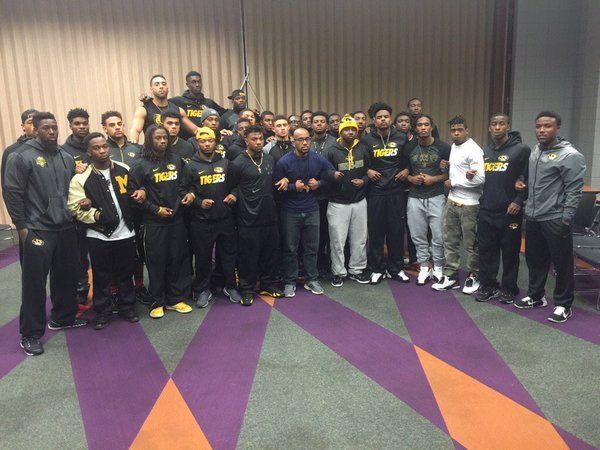
University of Missouri's Football Team Protests Against Pres. Tim Wolfe


Link: http://www.cnn.com/2015/11/08/us/missouri-football-players-protest/index.html

Date: November 8, 2015

Summary: African American football players from the University of Missouri have joined forces in protest against the Missouri System President Tim Wolfe for his lack of action against the racism that appears on campus. The University of Missouri has an abundance of white students and many cases of students openly using racial slurs, yet, Wolfe has done nothing to stop them. One of the most recent incidents happened in August when a student used feces to draw a swastika on a dorm's wall, which offended not only the Jewish student organization, but the Black student organization as well. Because of the many incidents, the players refuse to participate in any activities related to football, meaning practices or games, until Wolfe resigns or is fired. One graduate student, Jonathan Butler, is even going on a hunger strike until Wolfe is removed from his position. Butler stated that "students are not able to achieve their full academic potential because of the inequalities and obstacles they face". Later, Butler included that he is "in this because it's that serious" and "at this point we can't afford to continue to work with individuals who just don't care for their constituents".

Questions: Has racism improved from what it was in the past or is it just the same? What actions would you take as the president of Missouri's four-campus university system to end racism on campus? Should race be factor when admitting students into colleges to even out the demographics? Why or why not?

Monday, November 2, 2015

Transgender Student Rights


Link: http://www.nytimes.com/2015/11/03/us/illinois-district-violated-transgender-students-rights-us-says.html?action=click&pgtype=Homepage&module=first-column-region&region=top-news&WT.nav=top-news&hp&_r=0


Title: 

Illinois District Violated Transgender Student’s Rights, U.S. Says

Date: November 2nd, 2015

Summary: Recently, the school district in Palatine, Illinois, was under fire for violating transgender rights which was because they were limiting them the use of gender specific bathrooms. In this specific case, a transgender female was restricted in using the women's bathroom, for it "made other students feel uncomfortable." The school decided that she should change behind a curtain, however, "the school district in Palatine, Ill., has not yet come to an agreement, prompting the federal government to threaten sanctions."   The Office for Civil Rights of the Department of Education sent in a letter to the school board stating that all transgender students should have access to the facilities of their choosing, and that restricting transgender people is a violation of their rights under Title lX, which bans sex discrimination in schools and the use of private and separate bathrooms. The superintendent, Dr. Cates, said "parents had made it resoundingly clear that they favored 'maintaining some measure of privacy expectation' in the locker rooms." This is not an uncommon issue, for many school districts all around the US are struggling to find common ground on integrating transgender students in school, which includes locker rooms and sports teams. 

Questions: What is more important, freedom of privacy or expression? Do you believe that transgender people should have the choice in what bathroom to go in or what sports team to join? Why or why not? Lastly, should this be a school wide decision, state wide decision or a nationwide decision?

Assault Weapons Ban Before Supreme Court


Link: http://www.nbcnews.com/news/us-news/assault-weapon-ban-u-s-supreme-court-n442056

Summary:

Recently, gun violence and possible gun regulations have been a major issue in the United Sates. One case in particular is challenging a law in Chicago that bans certain firearms (such as the common AR-15 and AK-47 rifles) as well as guns classified as assault weapons. Specifically, the law bans the sale, purchase, and possession of semi-automatic guns that can hold over 10 rounds of ammunition in a single ammunition clip/magazine.

The reasoning behind this was that these weapons need to be reloaded less frequently, which means that they can fire rapidly and cause more injuries. This law was upheld by a federal district judge as well as a federal appeals court panel. Judge Frank Easterbrook, who wrote the opinion on the case ruling, said that the law was upheld to "reduce the carnage if a mass shooting occurs".

The Illinois Rifle Association is currently challenging the law and its constitutionality. According to the Second Amendment, individuals have a right to own firearms for self defense. On top of that, the association is also stating that some of the firearms being banned are "in no way unusual," and even protected in other states by laws banning communities from restricting the sale of them. If the Supreme Court decides to hear the case, this law and others like it banning the sale of certain guns could be ruled unconstitutional and be abolished. However, if the Supreme Court rejects the case, the law would stand, and would boost efforts for other laws trying to impose bans on the possession of firearms.

Questions: Is this law banning the sale and possession of certain firearms unconstitutional, or would it help regulate gun violence? Should the Supreme Court decide to hear the case, and if so, what do you think the decision should be?